


Modern interiors have a habit of looking good in photographs and feeling cold in real life. Clean lines, neutral walls, minimal furniture. Everything is in its right place, but something is still missing. More often than not, that something is a painting.
Wall art paintings aren’t decoration in the shallow sense. They’re what give a modern space a point of view. Without them, the room might as well be a hotel lobby.
Art does what furniture simply can’t
Furniture gives a room its function. Art gives it its character. These are two completely different jobs.
You can spend a lot of money on the right sofa and still have a room that feels generic. But a single well-chosen canvas wall art piece above that sofa can make the entire room feel intentional. Designers talk about this a lot: the art comes first, and everything else gets arranged around it. Colour choices, accent pieces, and even the direction of lighting often trace back to what’s on the walls.
In modern interiors specifically, where the palette tends to be restrained, and surfaces tend to be flat, abstract wall art or contemporary paintings carry most of the visual energy in a room. They introduce texture, movement, and colour in a way that doesn’t conflict with the clean aesthetic. They earn their place.
The brain responds to art faster than you’d expect
Nearly 90% of visual cues reach the brain in under a tenth of a second, and colour drives much of that response. This happens before conscious thought. Before you’ve decided how you feel about a room, your nervous system has already started reacting to what it sees.
Blue tones calm and sharpen focus. Red raises alertness and appetite. Green eases eye fatigue. These aren’t abstract colour theory claims. They’re documented physiological responses.
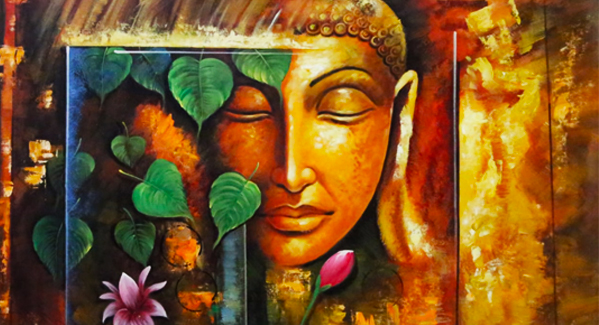
This makes the case for wall art for living rooms and bedroom wall art that’s chosen with intention rather than just picked to fill a gap. A botanical wall art print in soft greens and earthy tones in a bedroom genuinely helps the body settle in the evenings. A bold abstract canvas with warm tones in a home office can keep energy levels up during a slow afternoon.
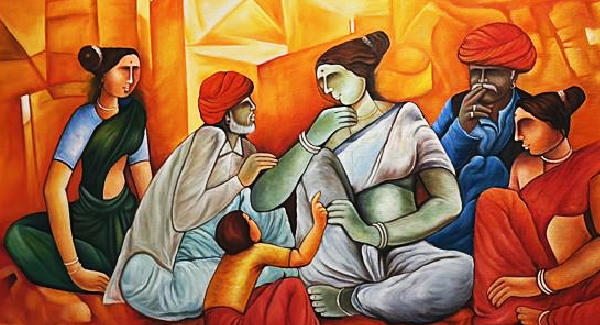
Art also activates dopamine release when a viewer feels a personal connection to the piece. Familiar imagery, culturally resonant subjects, or images tied to a personal memory all trigger that response. That’s why personalised wall art and Indian traditional art carry a weight in Indian homes that a generic print simply doesn’t.
Modern Indian interiors are doing something different now.
Indian art forms like Madhubani paintings, Warli art, Pattachitra, and Rajasthani miniatures are increasingly being used as focal points in modern homes, not as ethnic accessories, but as the design centrepiece. The approach has shifted. These aren’t hung to signal cultural awareness. They’re hung because they’re visually powerful and because they give a room depth that contemporary minimalism alone rarely achieves.
The Indian wall art market generated USD 5,305.8 million in revenue in 2025 and is projected to reach USD 9,857.4 million by 2033, growing at a CAGR of 8.2%. That growth reflects a genuine change in how Indian homeowners think about their walls. Art buying has moved out of galleries and into everyday home furnishing decisions.
The rise of platforms where you can shop for wall art paintings online in India has made this shift possible for buyers outside the four major metros. Someone decorating a flat in Pune or Jaipur can browse original hand-painted canvas art, limited-edition prints from contemporary Indian artists, and traditional folk art styles all in one sitting, without travelling to a gallery or knowing an art dealer.
Art solves real spatial problems in modern flats.
Here’s something worth knowing, particularly for Indian apartments where rooms tend to be compact. Large wall art placed correctly can make a small room feel bigger.
A horizontal canvas at eye level in a narrow room draws the eye sideways, which makes the space feel wider. A tall painting in a low-ceilinged room gives the eye somewhere to travel upward, and the ceiling feels higher. Designers have used this optical effect for decades, and it works whether the space is 200 square feet or 2,000.
Geometric wall art and minimalist paintings are particularly effective in compact modern interiors because they create visual interest without visual clutter. A single bold piece in a room with very little else going on doesn’t overwhelm the space. It completes it.
This is also why wall art can be a more practical investment than additional furniture in a small flat. Another shelf or side table competes for floor space. A painting uses the one surface every room has in abundance: the wall.
Choosing art for specific rooms in a modern home
Modern interiors have different visual demands from room to room. A quick, practical guide:
- Living room: Go larger than feels comfortable. A large canvas painting above the seating needs enough scale to balance the furniture beneath it. Anything too small looks lost.
- Bedroom: Muted tones, calmer subjects. Landscape paintings or soft abstract pieces work well here. Avoid visually complex or high-contrast work directly above the bed.
- Home office: Abstract art with geometric forms helps maintain focus. Nature prints also reduce stress in work environments.
- Dining room: This is where bolder choices pay off. Warmer colours, stronger contrasts, larger subjects. Traditional Indian paintings with rich palettes suit this space well.
- Entryway: One strong piece. A well-scaled framed painting in the entrance sets the tone for the whole home before anyone sees the rest of it.
Why shopping for art online makes sense now?
Until a few years ago, buying original art in India meant visiting galleries, dealing with high prices, and having limited access outside big cities. That has changed significantly.
You can now shop wall art paintings online in India and access a range of work that spans original oil paintings, watercolours, folk art, and contemporary abstracts, all with clear pricing, artist backgrounds, and direct delivery. The GST on fine art was reduced from 12% to 5% in late 2025, which brought original artwork meaningfully within reach for more buyers.
For anyone who hasn’t yet explored it, the range available when you shop for wall art paintings online in India is broader than most people assume. It’s not just prints. Original canvases, handmade works on paper, mixed-media pieces, and curated sets for gallery walls are all available from independent Indian artists and established art platforms.
The room you spend the most time in deserves attention on the walls
Modern interiors work best when the restraint of the design is balanced by something that carries genuine visual energy. Bare, minimalist walls can read as either considered or empty depending on what’s missing from them. Wall art paintings are what tip that balance toward consideration.
The next time a room feels incomplete despite ticking every other box, look at the walls. That’s usually where the answer is. And if you’re ready to do something about it, there’s never been a better time to shop for wall art paintings online in India and find something that actually means something to you.
