

You live in a small village in medieval Europe, and the only place in your town with any decoration is the local church. The walls are covered in painted scenes: a man being born in a stable, a figure feeding a crowd with bread and fish, and a man on a cross. You have never held a book, but you know every one of those stories. That is exactly what religious paintings were designed to do, and that practical, emotional power is why they changed everything about how humans make and experience art.
Art Was Born in Sacred Space
The oldest surviving Christian paintings date to around 70 AD, found at a site in Megiddo. Early Christians hiding in Roman catacombs painted fish, lambs, and shepherd figures on underground walls because open religious expression was dangerous. They kept the images simple, almost like a private code. But the impulse behind them was the same one that would eventually produce the Sistine Chapel: the need to make faith visible.
In the Byzantine era, roughly 330 to 1453 AD, this evolved into icon painting. Artists created highly structured images of Christ, the Virgin Mary, and saints backed with gold leaf. These were not decorative objects. People prayed directly in front of them. They were treated less like paintings and more like doorways, something you look through rather than just at. That idea of an image as a point of contact with something beyond itself is ancient, and it never fully left art even as the world became more secular.
The Renaissance Brought Emotion Into It
Up until the Renaissance, religious figures in paintings were deliberately distant. They were shown with rigid postures, flat gold backgrounds, and expressions that conveyed authority rather than feeling. Then artists like Leonardo da Vinci, Michelangelo, and Raphael started doing something different. They made the figures human.
Look at the Creation of Adam on the Sistine Chapel ceiling. God reaches toward Adam, and Adam reaches back. Neither of them looks like a symbolic figure on a mosaic. They look like two beings in an actual moment of connection. Michelangelo painted that ceiling between 1508 and 1512, and the gap between those two fingers remains one of the most immediately recognisable images on earth.
What the Renaissance artists figured out was that religious paintings hit harder when the figures inside them feel real. And in working out how to make that happen, they developed techniques in perspective, anatomy, light, and composition that became the foundation of Western fine art for the next five centuries.
One Third of Europe’s Great Art Collections
Here is a number that puts the scale of this in context. Roughly one-third of the paintings in London’s National Gallery, one of the largest Western art collections in the world, are of religious subjects. That proportion reflects how completely religious patronage drove European art from the 13th century onward. Artists were not just spiritually motivated. They were paid by the Church, by monasteries, by wealthy patrons seeking divine favour. The commission created the art.
Leonardo’s Last Supper, painted between 1495 and 1498, was made for the dining room of a monastery in Milan. It is now one of the most reproduced images in human history. It was not made to become iconic. It was made because a religious institution needed a painting for a specific wall, and the greatest painter alive was asked to do it.
India’s Own Parallel Tradition
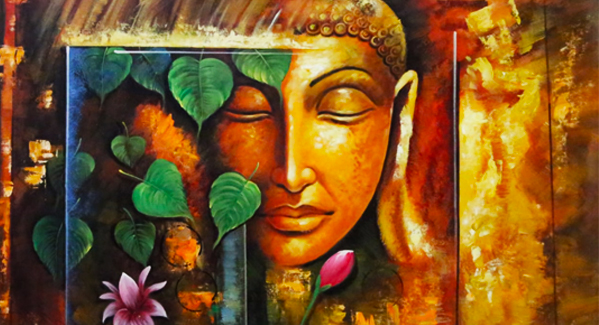
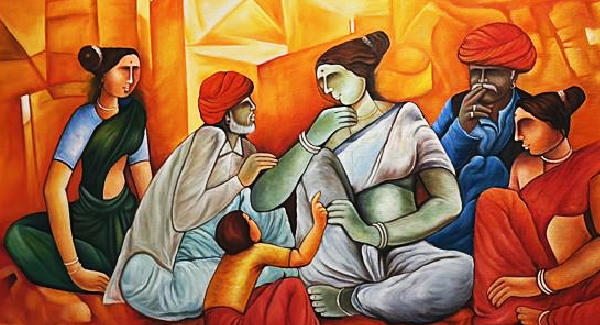
Religious paintings are not just a European story. India’s visual traditions grew almost entirely from devotional practice. Tanjore paintings from Tamil Nadu, with their raised gold foil surfaces and vivid colours, were made as objects of daily home worship. Madhubani paintings from Bihar were drawn by women on the walls of homes during religious ceremonies and festivals. Pattachitra scrolls from Odisha depicted the stories of Lord Jagannath and were used in temple processions.
These were not fine art in the gallery sense. They were functional sacred objects that happened to require extraordinary skill. The fact that they survived is because living religious traditions kept them in use across generations, a very different kind of preservation from a museum archive.
What the Reformation Broke and What It Built?
In the 16th century, the Protestant Reformation dramatically interrupted Europe’s religious art tradition. Protestant reformers argued that images in churches encouraged idol worship, and in several countries, artwork was physically destroyed or stripped from church walls. In Protestant regions, commissions collapsed almost overnight.
The unexpected result was that painters who could no longer earn a living from religious subjects had to find other subjects fast. Dutch artists turned to domestic scenes, landscapes, and portraiture. Still-life painting as a serious art form developed directly from this pressure. The whole genre of everyday life as worthy subject matter for skilled painting grew out of religious politics, forcing artists to look elsewhere.
Religious Themes Never Left Modern Art
There is a widespread assumption that serious modern art moved on from religion entirely. It did not. Salvador Dalí’s surrealism was directly shaped by his Catholic faith. His painting The Sacrament of the Last Supper, completed in 1955, uses geometric precision and dreamlike floating figures to reimagine a subject Leonardo had painted 450 years earlier. Andy Warhol attended mass throughout his adult life, and his repeated iconic imagery carries an unmistakable quality of devotional repetition.
Contemporary artists today continue working with religious themes, blending traditional iconography with modern aesthetics and cross-cultural spiritual influences. Religious paintings remain a category in active production globally, not as museum relics but as living art made for homes, places of worship, and personal devotion.
Why do they still move people?
The honest reason religious paintings continue to affect people, including those with no religious belief at all, is that they were made to address universal human experiences. Birth, death, suffering, love, forgiveness, and the search for meaning. Those experiences have not changed.
A 15th-century altarpiece painting of grief-stricken figures around a crucified body is drawing on the same emotional territory as any powerful artwork made today. The subject is specific to one faith tradition. The feeling underneath it is not. That is the gap religious paintings have always known how to cross, and it is why they are still standing after everything else around them changed.
