



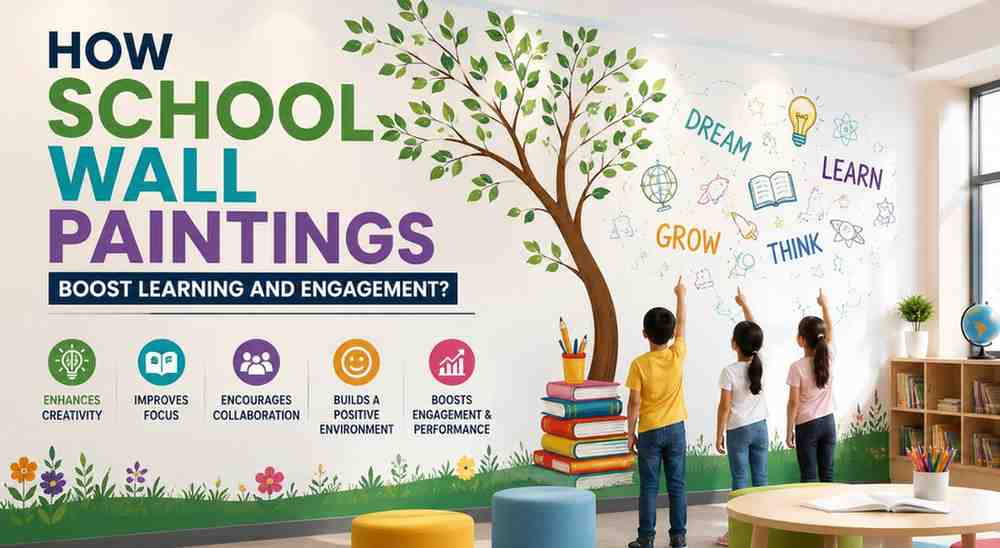
A school wall can do more than fill a space. When it is planned well, it helps children notice ideas faster, remember them better, and feel more connected to the place where they learn. That is the real value of School Wall Paintings. They make the room do part of the teaching.
Why do walls matter so much?
Children spend a lot of time looking around the room, even when they are not meant to. A blank wall gives them nothing useful to hold onto. A painted wall can repeat a lesson, show a story, or set a mood without asking for extra class time. That is why School Wall Paintings can matter more than people first think.
A simple example helps. Put a number line near the junior classroom door, a map outside the social studies room, or an alphabet mural in the early years block. Students see those things again and again. That steady exposure builds familiarity. And familiarity makes learning less shaky.
How do they help visual learning?
Some children remember what they hear. Others remember what they see. A good wall painting gives both groups a better chance. It turns a hard-to-grasp idea into something visible. That matters with younger students, but it helps older ones too.
Take a science wall with the water cycle, or a corridor mural with punctuation marks and sentence examples. Students do not need to stop and study it every time. The point is that they keep passing it. The image starts to stick in the background of their mind. That is one reason School Wall Paintings work well for retention.
They keep the lesson in sight long after the teacher has moved on.
There is also a simple truth here. Children often trust what they can see faster than what they can only hear once. A wall chart with a visual path or a mural with labeled parts of a plant can help the concept feel less abstract. It becomes a thing, not just words on a page.
Do they really keep students more engaged?
Yes, but only if the art feels connected to the school day. Murals that reflect class themes, student work, values, or local stories tend to pull more attention than random decoration. A wall that matches the lesson or the school culture gets noticed. A wall that looks generic gets ignored.
This is where School Wall Paintings do a quiet kind of work. They break the sameness of school routines. They also give students something to talk about. A child may point to a mural and ask a question. Another may notice something in it that connects to a lesson. That small moment often matters more than a polished slogan on the wall.
When students help choose or paint the mural, the effect gets stronger. They feel ownership. They feel seen. And when that happens, the wall stops being background. It becomes part of the school story.
What should schools paint on the walls?
The best answer is simple: paint what students will actually use. That can mean letters, maps, shapes, timelines, science diagrams, reading prompts, or local culture. It can also mean values like kindness, respect, teamwork, or curiosity if those are shown in a way children can understand fast.
You do not need to pack every wall with content. That usually goes wrong. Too much visual noise can make a room tiring instead of helpful. One strong idea on one wall is often better than six scattered ideas on six walls. Good School Wall Paintings should support the room, not fight it.
Here is a practical split:
- Early years areas work well with animals, shapes, colors, and alphabet themes.
- Primary classrooms can use counting, weather, simple maps, and story scenes.
- Older students may benefit more from science diagrams, vocabulary walls, and historical timelines.
Where do they work best in a school?
High-traffic spots usually give the best return. Corridors, entrances, stairways, libraries, and shared learning zones are places students keep seeing all day. Those repeated views matter. A mural hidden in a side room may look nice, but it will not do much if hardly anyone sees it.
Classrooms need a lighter touch. One wall can carry the learning theme. Another can stay cleaner so students do not get distracted. That balance matters more than people think. School Wall Paintings are most useful when they help students focus, not when they turn the whole room into visual clutter.
What happens when students help create them?
Something simple changes. The wall becomes theirs. That is a big deal in a school. Projects that involve students in planning or painting tend to build stronger community ties, more pride, and better connection to the school. Students also tend to respect the finished work more when they had a hand in it.
It does not have to be a full-scale art project. Sometimes students sketch ideas, vote on themes, color smaller sections, or help with a border design. Even small tasks matter. They give the child a real role instead of just a seat in front of the board. That is where School Wall Paintings become more than art. They become shared work.
What should schools avoid?
The biggest mistake is painting walls for adults instead of children. A wall may look impressive in photos and still do nothing for learning. If the text is too small, the colors are too busy, or the theme has no clear link to the age group, students will stop noticing it fast.
Another mistake is poor upkeep. If the paint chips, the mural fades, or the artwork gets covered by posters and cables, the wall starts to feel neglected. Schools that use wall art well usually think about durable materials, safe paint, and a plan for future touch-ups. That part is not exciting, but it matters.
What is the simple takeaway?
Keep the wall useful. Keep it readable. Keep it tied to real school life. A strong mural should help a child remember a lesson, feel welcome in the building, or notice something they would have missed otherwise. That is the job.
When School Wall Paintings are done well, they do not just brighten the space. They help students look, think, and stay interested a little longer. And in a school, that extra attention is worth a lot.
