

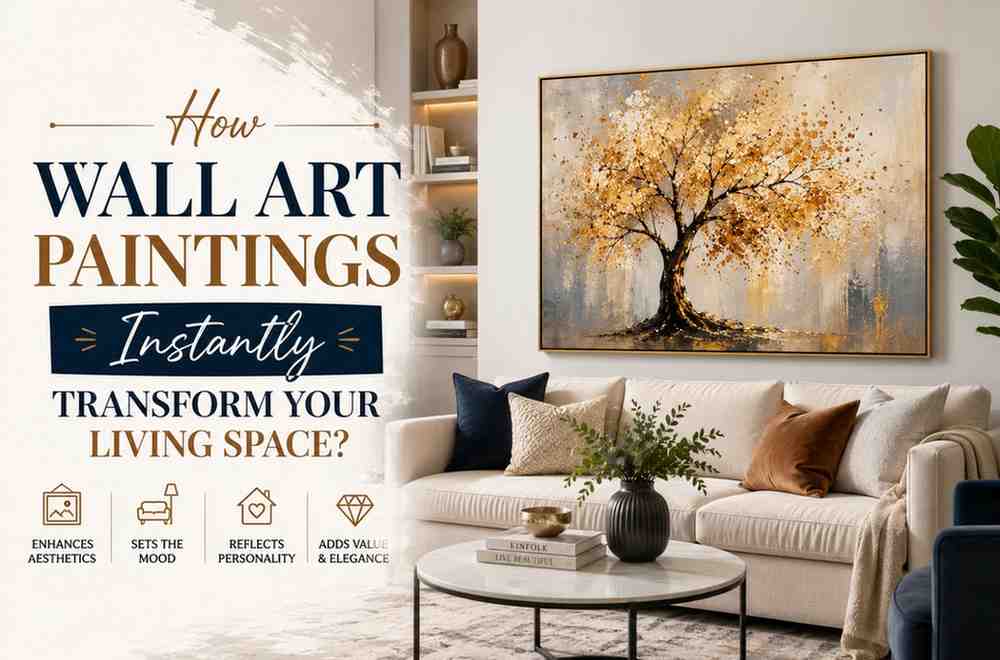
Picture two identical flats, same size, same layout, same furniture. One has bare white walls. The other has a large abstract canvas above the sofa and a small framed print near the window. The second flat feels warmer, more considered, more like someone’s home. Nothing structural has changed. Just the walls.
That’s how quickly wall art paintings shift the feel of a space. Not over time. Immediately.
The eye lands on the walls before anything else.
This isn’t a design opinion. It’s how vision works. When you step into a room, your eyes scan the largest surfaces first, and walls are almost always the largest surface. If those walls are bare, the brain reads the room as unfinished, regardless of how good the furniture is.
A well-placed canvas wall art piece stops that scan. It gives the eye a place to settle, and the rest of the room benefits from that anchor. Interior designers describe this as creating a focal point, the visual centre of gravity that pulls a room together.
Research confirms the speed of this response. Nearly 90% of visual cues reach the brain in under a tenth of a second, and colour triggers physical reactions before conscious thought. A painting with warm amber and terracotta tones makes a room feel lived-in and inviting within seconds of being seen. A cool,l blue abstract does the opposite. It settles the nervous system and makes a space feel calm and controlled.
You’re not imagining it when a room “feels different” after adding art. The shift is neurological.
A single painting can sort out a room that feels off
Most living rooms that feel “not quite right” share one problem. The furniture is fine, the colours are inoffensive, but nothing reads as intentional. There’s no visual hierarchy. The room doesn’t have a beginning.
One large wall art piece placed at the right scale changes that completely. It becomes what the room is organised around. Sudde, only the sofa placement makes sense because it faces the painting. The lamp beside it makes sense because it complements the palette. Choices that seemed random start reading as deliberate.
This is why wall art for the living room isn’t something you add after everything else is done. For rooms that feel underdirected, the painting is often what should go in first, with the furniture arranged in relation to it.
Scale matters here more than style. A canvas that’s too small for the wall it’s hung on makes the room feel more uncertain, not less. Go bigger than feels instinctively safe. Most people underestimate how much wall real estate a painting needs to hold.
Colour in art does things that paint alone cannot.
A painted wall gives you a flat plane of colour. A painting gives you colour with variation, depth, texture, shadow, and layering. The visual richness is completely different, and the emotional effect follows from that.
Abstract wall art with deep blues and greens calms the space and promotes focus, a useful quality in a living room that’s also used as a reading or work area. Warm earth tones in a landscape wall art piece create a sense of comfort and groundedness. Black-and-white photography with strong compositional clarity reads as sharp and focused, well-suited for a home office corner or a hallway.
Indian homes, where living spaces often do multiple jobs simultaneously, benefit particularly from this kind of visual steering. A room that’s used for work in the morning and relaxation in the evening can be tuned partly through the art that hangs in it.
Traditional Indian art forms like Madhubani paintings and Warli art bring a completely different quality. The dense patterning, the natural pigments, and the cultural symbolism add layers of meaning that a mass-produced print simply can’t replicate. A single authentic folk art piece on the main wall of a living room changes the entire register of the space.
Art changes how a room’s size feels, not just its mood.
This is one of the most practically useful things wall art paintings can do in Indian homes, where rooms are often compact.
Larger artwork makes a small room feel bigger by giving the eye a strong point of focus and reducing the sense of visual clutter from multiple smaller objects. Horizontal compositions draw the eye sideways and make a narrow room feel wider. Lighter backgrounds with expansive imagery, open skies, seascapes, or minimalist landscapes, create a sense of breathing room that a blank wall with furniture pushed against it never achieves.
Conversely, darker, densely detailed oil paintings in a large open-plan space create intimacy. They make a cavernous room feel anchored and cosy rather than cold. The same principle that lets art make a small space feel bigger also lets it make an oversized space feel more human.
A framed painting hung at eye level in the main sightline from the entrance also shapes first impressions decisively. You’re not walking into a functional box. You’re walking into a space with a point of view.
Choosing what to hang and where
A few simple decisions make the difference between art that transforms a room and art that just sits on a wall:
- Scale first: The artwork should be roughly two-thirds the width of the furniture it’s hung above. Too small reads as hesitant.
- Height: Eye level is the standard, roughly 145 to 150 cm from the floor to the painting’s centre. Hanging too high is the most common mistake.
- Colour relation: The art doesn’t need to match the room’s palette, but it should speak to it. One colour from the painting should appear somewhere else in the space, even subtly.
- Subject for the room: Calmer imagery in bedrooms, energising or culturally rich pieces in living areas, nature or geometry in home offices.
- Single statement vs. gallery wall: A single large piece creates authority. A gallery wall of smaller pieces creates warmth and personality. Both work, but for different rooms and different effects.
Getting the right piece without the gallery trip
Finding art used to mean visiting galleries or knowing the right people. That’s changed completely. You can now order wall art paintings online in India and access original works, limited-edition prints, folk art, and contemporary canvases all in one place, with clear artist information, sizing options, and doorstep delivery.
For those decorating a new flat or refreshing an existing space, the ability to order wall art paintings online in India means the process is no longer limited to what’s physically within reach. Platforms like IndianArtZone, Gallerist, and ArtZolo carry original hand-painted canvases by Indian artists across every style and price range.
The GST reduction on fine art in late 2025, from 12% to 5%, made original artwork meaningfully more accessible for everyday buyers, not just collectors. If you’ve been waiting for the right time to order wall art paintings online in India and invest in something original, the conditions are better now than they were a year ago.
