

Vaastu-inspired canvas art combines traditional symbolism with contemporary interior decoration. Buyers often choose it to express cultural values, create a desired visual mood, or connect a room with familiar motifs. Yet a suitable painting must also fit the wall, furnishings, lighting, safety needs, and budget. Thoughtful selection therefore involves more than choosing an auspicious-looking image.
It requires careful evaluation of symbolism, colours, dimensions, materials, printing quality, seller information, installation, and maintenance, while recognising that traditional interpretations vary and do not guarantee particular outcomes.
What Is a Vaastu Canvas Painting?
A Vaastu canvas painting is artwork printed or painted on canvas and selected according to traditional Vaastu ideas about imagery, colour, direction, and room function. It may depict horses, waterfalls, nature, spiritual figures, or symbolic motifs. Such associations reflect cultural beliefs, not scientifically established effects on health, prosperity, relationships, or success.
Unlike a conventional decorative print chosen solely for appearance, Vaastu-inspired artwork carries an additional symbolic purpose. However, the object remains a décor product whose measurable qualities include resolution, fabric, ink, frame construction, dimensions, coating, mounting system, and durability.
Buyers considering canvas paintings for Vaastu should therefore examine two separate questions. First, does the subject suit their preferred traditional interpretation? Second, does the product meet practical standards for visual quality, proportion, safety, and value? Keeping these questions separate prevents symbolic claims from overshadowing obvious purchasing concerns.
How Should Traditional Symbolism Influence Selection?
Traditional symbolism can inform a purchase, but it should remain one consideration among several. Different households, regions, and practitioners may interpret the same image differently. Consequently, buyers should treat directional and symbolic recommendations as preferences rooted in tradition rather than universal rules.
Vaastu paintings for home often appeal because they connect interior decoration with familiar cultural meanings. Nevertheless, no painting can independently produce wealth, peace, recovery, career advancement, or harmonious relationships. A pleasing image may influence how occupants perceive a room, but personal response depends on taste, memories, lighting, colour balance, and the surrounding environment.
Before selecting an image, ask:
- What does the subject traditionally represent?
- Does that interpretation align with the household’s beliefs?
- Will every regular occupant feel comfortable seeing it?
- Does its mood support the room’s actual purpose?
- Does it coordinate with the existing colour palette?
- Can the wall safely accommodate its dimensions and weight?
- Would the artwork still feel appealing without its symbolic label?
This approach preserves cultural meaning while supporting a rational buying decision.
Which Popular Subjects Suit Vaastu-Inspired Interiors?
Popular subjects include horses, peaceful figures, flowing water, landscapes, flowers, trees, and sacred motifs. Each carries commonly stated associations, although meanings can change across traditions. Therefore, buyers should examine the composition itself rather than relying only on a product title.
Seven Horses and Running Horses
A seven-horse canvas painting for Vaastu is traditionally associated with progress, momentum, strength, and collective movement. Buyers commonly prefer compositions in which all horses appear healthy, balanced, and moving together. Clear expressions, complete bodies, and an open visual path usually create a more coherent decorative result.
Similarly, a running horse canvas painting for Vaastu often symbolises ambition or forward motion. However, visual direction matters aesthetically. Horses appearing to run into the room can feel more contained than animals seemingly leaving the frame towards a doorway. This remains an interpretive preference, not a verified rule.
Examine the background carefully. Storms, aggressive expressions, collisions, broken terrain, or visibly distressed animals may create tension, even when the listing describes the image positively. Moreover, overly saturated highlights can make white horses appear flat and erase important details.
Buddha Imagery and Spiritual Motifs
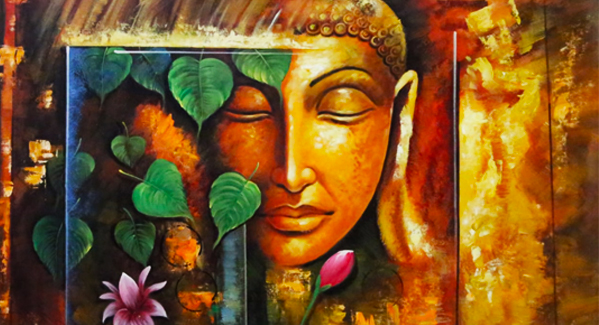
A Buddha canvas painting for Vaastu is commonly believed to represent calmness, reflection, and composure. Select respectful imagery with a serene expression, balanced cropping, and enough negative space around the figure. Avoid placing culturally significant imagery where it may face routine splashes, grease, footwear, or careless handling.
Spiritual canvas paintings for Vaastu may include sacred geometry, deities, meditative figures, lotus motifs, or traditional symbols. Cultural suitability matters more than fashion. Therefore, household members should agree on the image, its location, and the level of reverence it deserves.
A decorative spiritual image should never support promises of healing, protection, or guaranteed fortune. Instead, choose it because its symbolism and appearance feel appropriate for the space.
Waterfalls and Flowing Water
A waterfall canvas painting for Vaastu is often selected to symbolise movement, abundance, or continuity. From an interior perspective, water imagery can also soften a rigid room and introduce cooling blue, white, or green tones.
Study the picture’s atmosphere before purchasing. A clear, gently flowing waterfall may feel restful, whereas dark floods, violent waves, or gloomy skies can create unease. Likewise, the water’s visual direction should work with the room composition instead of pulling attention towards an awkward corner.
Traditional opinions about water placement differ. Accordingly, buyers who follow a specific school of Vaastu may wish to confirm its preferred direction before drilling the wall.
Nature, Flowers, and Landscapes
Nature canvas paintings for Vaastu offer broad decorative flexibility because landscapes can suit living rooms, passages, dining areas, and workspaces. Green foliage, flowering trees, open skies, mountains, and sunrise scenes are commonly believed to represent renewal, stability, vitality, or optimism.
Composition still determines suitability. For instance, a tranquil landscape may complement a bedroom, while an energetic sunrise can suit a workspace. In contrast, barren trees, desolate roads, predatory scenes, and severe weather may conflict with the atmosphere many buyers seek.
When choosing positive-energy canvas paintings, assess whether the actual colour, brightness, and subject make the room feel welcoming. The label itself provides no measurable evidence that the image changes energy or events.
Prosperity Symbols
Prosperity canvas paintings for home may feature lotus flowers, trees, coins, elephants, fish, harvest imagery, or richly coloured traditional motifs. These subjects are commonly associated with abundance or good fortune, yet interpretations vary significantly.
Avoid selecting a prosperity image solely because a listing predicts financial results. Instead, consider its artistic quality, cultural relevance, colour harmony, and ability to hold attention without dominating the room. Responsible sellers describe symbolism carefully and avoid guaranteed monetary claims.
How Can Buyers Choose Artwork for Each Room?
Room function should lead the selection process. An image suited to a lively reception area may feel stimulating in a bedroom, while delicate artwork designed for a quiet corner may disappear on a large office wall.
Living Room
Vaastu paintings for living room spaces usually work best when they provide a clear focal point without competing with the television, decorative lighting, or patterned furniture. Landscapes, horses, botanical compositions, and refined traditional motifs can suit this shared area.
Measure the wall above the sofa or console before ordering. As a practical decorative principle, artwork should relate visibly to the furniture beneath it rather than appearing isolated or excessively wide. Moreover, leave enough breathing space around switches, sconces, shelves, and ceiling mouldings.
Choose colours already present in cushions, rugs, curtains, or wood finishes. Repetition creates visual unity, whereas one or two contrasting shades can add controlled emphasis.
Bedroom
Vaastu paintings for bedroom interiors should support a restful visual atmosphere. Soft landscapes, paired botanical forms, gentle florals, abstract curves, and muted natural scenes often work better than aggressive animals, battle imagery, harsh geometric contrasts, or turbulent water.
Personal comfort remains essential because occupants see the artwork frequently. Therefore, couples should agree on symbolic imagery rather than assuming a traditionally recommended subject will suit both people.
Avoid hanging heavy frames directly above a bed unless the wall structure, mounting hardware, and installation method can safely support them. A side wall may provide a safer position and a more comfortable viewing angle.
Entrance and Dining Area
At an entrance, artwork establishes the first visual impression. Select a welcoming composition that fits the available wall without obstructing doors, security devices, switches, or movement. Bright landscapes, floral scenes, or restrained traditional motifs can work well when lighting remains sufficient.
Dining spaces benefit from warm, sociable imagery. Botanical art, tasteful food-related compositions, fields, flowers, or gentle nature scenes can support a relaxed atmosphere. However, avoid canvases where cooking fumes, oil, or repeated contact will cause staining.
Anyone planning to buy Vaastu wall art online should compare listing colours with the dining room’s actual lighting. Warm bulbs can shift whites towards cream and make reds or oranges appear stronger.
Workspace and Office
Vaastu paintings for office interiors commonly use horses, mountains, rising sunlight, green landscapes, or restrained abstract compositions. Such subjects may traditionally symbolise progress, stability, clarity, or growth, although they cannot ensure commercial success.
In practical terms, office art should suit the organisation’s character and remain appropriate for employees, clients, and visitors. A reception wall can carry a stronger focal image, while work areas usually benefit from calmer visual detail.
Keep artwork away from presentation screens, safety signage, glass reflections, and busy noticeboards. Moreover, use secure mounting in corridors and customer-facing spaces where accidental contact is more likely.
What Role Does Direction Play in Placement?
Direction matters within many Vaastu traditions, but recommendations differ by source, subject, and interpretation. Buyers should therefore avoid treating a single online diagram as universally authoritative. Room layout, natural light, furniture placement, wall condition, and safe installation may impose more immediate constraints.
Common discussions connect water scenes with certain northern or eastern locations, horses with progress-oriented areas, and calming spiritual imagery with quiet zones. However, these associations remain traditional interpretations rather than experimentally verified cause-and-effect relationships.
Use this practical sequence:
- Identify the available walls and their directions accurately.
- Check whether your preferred tradition recommends the selected subject there.
- Assess glare, sunlight, moisture, heat, and viewing distance.
- Confirm that doors, cupboards, and curtains will not strike the artwork.
- Choose a position that feels balanced from the main viewing point.
- Use suitable mounting hardware for the wall and product weight.
When tradition conflicts with safety or functionality, prioritise secure installation and room usability. Tenants should also check rental conditions before drilling.
How Should Colour Match the Room’s Function?
Colour influences visual character more reliably than symbolic marketing claims. Blues and greens often appear calm, while reds, oranges, and golds create stronger warmth and emphasis. Nevertheless, brightness, saturation, lighting, scale, and surrounding finishes can change how any colour feels.
Vaastu wall décor online India listings may show digitally enhanced colours. Consequently, request unedited product photographs when the distinction matters. Review images taken from different angles, and check whether customers mention significant variation between the listing and delivered print.
For coherent colour coordination:
- Repeat two or three existing room colours within the artwork.
- Use strong contrast only when the wall needs a focal point.
- Choose softer saturation for bedrooms and compact rooms.
- Consider warmer tones for social areas with neutral furniture.
- Test how artificial lighting affects metallic or glossy details.
- Avoid dark, dense compositions on poorly illuminated walls.
- Remember that screen settings can distort colour accuracy.
A symbolic colour should not override personal comfort. If a traditionally suggested shade clashes strongly with the interior, a subtler version may preserve meaning while improving visual unity.
How Do Size, Shape, and Viewing Height Affect the Result?
Correct proportions make artwork feel intentional. Before ordering, record the wall’s width and height, nearby furniture dimensions, viewing distance, and obstructions. Masking tape can outline the proposed size, allowing occupants to judge the scale before purchasing.
Large horizontal canvases generally suit walls above sofas, sideboards, beds, or conference tables. Vertical artwork can fit narrow entrance walls, pillars, stair landings, and spaces between doors. Square pieces create balanced focal points, while grouped panels cover broader walls.
Measure systematically:
- Mark the maximum usable wall area.
- Subtract clearance for furniture, switches, doors, and lights.
- Note whether the listed dimensions refer to each panel or the complete arrangement.
- Check the required gaps between multi-panel pieces.
- Confirm whether frame dimensions increase the final footprint.
- View a taped outline from seated and standing positions.
- Verify that the centre sits near a comfortable viewing level.
Artwork hung too high can feel disconnected from furniture. Conversely, low placement invites accidental contact, particularly in homes with children or pets.
Which Canvas Format Should Buyers Choose?
The main formats include single-panel, multi-panel, framed, unframed, rolled, and ready-to-hang products. Each affects cost, installation effort, portability, and finished appearance.
Single-Panel and Multi-Panel Designs
A single panel offers visual continuity and usually simplifies alignment. It suits detailed portraits, spiritual figures, circular motifs, and compositions where splitting the subject would look awkward.
Multi-panel artwork can create movement across a wide wall. However, buyers must account for gaps, alignment, individual panel measurements, and additional hooks. Product photographs sometimes show panels closer together or larger than their actual scale, so rely on stated dimensions rather than mock-ups.
Check whether important faces, symbols, or animal bodies cross panel divisions. Poor splitting can weaken both visual clarity and respectful presentation.
Framed, Unframed, and Rolled Options
Framed Vaastu canvas paintings provide a finished edge and can add definition against a similarly coloured wall. Floating frames create a narrow visible gap around stretched canvas, while conventional outer frames may partly cover its edges. Frame material, corner joins, depth, colour, and weight deserve close inspection.
Unframed stretched canvas offers a lighter, contemporary appearance. Wrapped edges may repeat, mirror, extend, or crop the image, so confirm the edge treatment before purchase.
Rolled canvas often costs less to ship and allows local framing or stretching. Nevertheless, the buyer must budget for stretcher bars, skilled labour, framing, and transport. Ready-to-hang products reduce preparation, although supplied hooks may not suit every wall type.
What Determines Canvas and Print Quality?
Material specifications reveal more than ornamental descriptions. A dependable listing should identify the canvas type, printing method, ink system, stretcher construction, surface finish, frame material, mounting provision, and final dimensions.
Cotton canvas can provide a traditional texture, while polyester canvas often supports consistent printing and dimensional stability. Blended fabrics combine characteristics of both. No material automatically guarantees excellence; weave consistency, coating, tension, and printing execution also matter.
Ask sellers about:
- Canvas composition and approximate thickness
- Pigment- or dye-based ink, if stated
- Claimed resistance to fading and its conditions
- Protective varnish or laminate
- Stretcher-bar material and depth
- Corner construction and rear finishing
- Frame composition and surface coating
- Hanging hardware and maximum supported weight
- Care instructions and warranty coverage
Never assume that “premium”, “museum quality”, or “high definition” represents a standardised grade. Sellers should support such language with specific product information.
Image Resolution and Colour Accuracy
Low-resolution source files may appear acceptable in thumbnails but become pixelated, soft, or jagged when enlarged. Product photographs should include close views showing facial details, fine lines, gradients, and textural areas.
For customised canvas paintings for Vaastu, provide the highest-resolution source available and request a digital proof. Confirm cropping, orientation, borders, text spelling, colour treatment, and final dimensions before approving production. Enlarging a small messaging-app image rarely produces a crisp large-format print.
Colour accuracy can vary between screens, printers, inks, canvas coatings, and lighting conditions. Therefore, ask whether slight variation falls within the seller’s return rules, especially when matching existing furnishings.
Finish, Coating, and Edge Treatment
Matte finishes reduce reflections and suit brightly lit rooms. Gloss finishes increase colour intensity but may show glare. Satin finishes offer a middle position, although appearance varies by manufacturer.
A protective coating can help with dust and minor surface exposure, but it does not make canvas waterproof. Likewise, laminated surfaces may simplify gentle cleaning while changing texture and reflectivity.
Inspect edges for clean wrapping, even tension, secure staples, neat backing, and protected corners. Uneven stretching may cause ripples, whereas weak stretcher bars can warp over time.
How Should Buyers Compare Online Listings?
Online comparison should focus on evidence rather than symbolic claims. Buyers viewing Vaastu canvas paintings online should compare equivalent dimensions, formats, materials, frames, finishes, and delivery terms before judging value.
When preparing to buy Vaastu canvas paintings online in India, create a shortlist based on complete product information. Listings should show the front, sides, back, frame joints, mounting hardware, close details, and an accurate scale reference. Styled room mock-ups can inspire placement, but they do not prove actual size or colour.
Evaluate seller credibility through:
- Clear business and contact information
- Consistent product specifications
- Original-looking product photographs
- Recent, detailed customer reviews
- Responses to quality or delivery complaints
- Written dispatch and delivery estimates
- Packaging information
- Accessible return and refund conditions
- Custom-order cancellation terms
- Warranty scope and exclusions
Buyers comparing Vaastu canvas paintings online with price should check whether the amount includes tax, framing, custom sizing, shipping, installation accessories, and cash-on-delivery charges. A lower displayed price may cover a smaller panel, rolled canvas, or an unframed version.
How Can Reviews and Photographs Be Assessed?
Customer reviews become more useful when they describe colour accuracy, canvas tension, frame strength, packaging, installation, and seller response. Ratings without detail offer limited evidence.
Look for customer photographs taken in ordinary rooms. These may reveal scale, gloss, edge finishing, or colour differences hidden by studio images. However, lighting and camera processing can still alter appearance.
Repeated wording, unrelated photographs, or unusually vague praise should not determine a purchase. Instead, compare patterns across critical and positive feedback. A seller’s constructive response to a documented problem can also indicate service quality.
What Should a Return Policy Cover?
Read the return policy before ordering, particularly for spiritual imagery and custom sizes. Confirm the return window, accepted reasons, required photographs, original-packaging requirement, reverse-shipping responsibility, refund method, and processing period.
Customised products may carry restricted returns unless they arrive damaged, defective, or materially different from the approved proof. Therefore, retain order confirmations, proofs, invoices, packaging photographs, and an unboxing video when practical.
Anyone seeking affordable Vaastu canvas paintings should calculate total ownership cost rather than choosing the smallest headline figure. Replacement framing, damaged delivery, weak hardware, or non-returnable printing errors can eliminate an apparent saving.
How Should Price and Value Be Compared?
Price commonly changes with dimensions, canvas fabric, ink, frame type, coating, customisation, packaging, and delivery distance. Since sellers may measure products differently, compare the finished external dimensions and included components.
A useful value comparison considers:
- Final size and number of panels
- Stretched, rolled, framed, or ready-to-hang format
- Canvas and ink specifications
- Image resolution and print consistency
- Frame material and construction
- Protective finish
- Included hardware
- Packaging strength
- Shipping charges and timelines
- Return rights and warranty terms
Shoppers who buy Vaastu wall art online should avoid assuming that the most expensive option provides the best print. Conversely, unusually cheap large artwork may use a weak frame, thin fabric, low-resolution image, or limited finishing. Product evidence should justify the difference.
How Can Artwork Be Installed Safely?
Safe installation requires matching the artwork’s weight and hardware to the wall material. Masonry, plasterboard, wood, tile, and partition walls need different anchors. When uncertain, use a competent installer, especially for large, heavy, glass-fronted, or multi-panel pieces.
Before drilling:
- Check for concealed electrical wiring and plumbing.
- Confirm the complete framed weight.
- Select anchors rated for the wall and load.
- Mark level points with accurate measurements.
- Keep clearance from doors, fans, curtains, and cupboards.
- Avoid positions vulnerable to moisture, steam, or cooking grease.
- Use two fixing points where rotation or tilting may occur.
- Add suitable restraints in homes with children or pets.
Do not place heavy artwork directly above seating or sleeping areas without reliable structural support. Furthermore, supplied hardware may be generic, so an installer should verify its suitability.
How Should Canvas Artwork Be Maintained?
Regular light care preserves colour, tension, and frame condition. Dust the surface gently with a clean, dry, soft cloth or a soft brush. Support the canvas from behind only when the construction permits, and never press hard against stretched fabric.
Keep artwork away from persistent direct sunlight, damp walls, air-conditioner discharge, bathroom humidity, and kitchen vapour. Moisture can encourage staining, mould, frame swelling, or loss of tension. Meanwhile, prolonged ultraviolet exposure may fade some inks.
Avoid household cleaners, wet cloths, abrasive sponges, perfume, incense smoke, and aerosol sprays. If a mark requires treatment, follow the seller’s written instructions. Periodically inspect hooks, wires, frame joints, canvas tension, and wall dampness.
Which Common Mistakes Should Buyers Avoid?
The most frequent mistakes involve believing guarantees, ignoring dimensions, relying on edited mock-ups, and choosing symbolism without considering the room.
Avoid these errors:
- Treating traditional associations as scientifically proven outcomes
- Purchasing imagery that makes occupants uncomfortable
- Assuming every Vaastu interpretation uses identical directional rules
- Ignoring final framed measurements
- Selecting a small print for an expansive wall
- Choosing an oversized piece for a narrow passage
- Ordering from low-resolution photographs
- Overlooking edge cropping in wrapped canvas
- Failing to check multi-panel spacing
- Confusing rolled canvas with ready-to-hang artwork
- Ignoring return restrictions for customised orders
- Installing heavy frames with unsuitable hooks
- Exposing canvas to sunlight, dampness, heat, or grease
- Using sacred imagery in an inappropriate or vulnerable position
- Paying extra for unsupported claims about luck or energy
Careful buyers select Vaastu-inspired artwork that remains attractive, practical, and meaningful even without promised results.
Pre-Purchase Checklist
Before placing an order, confirm every essential detail:
- The subject suits the room and household.
- Traditional symbolism matches the interpretation you follow.
- The direction remains practical and acceptable.
- Wall dimensions accommodate the complete product.
- Shape and orientation suit nearby furniture.
- Colours coordinate with actual room lighting.
- Image resolution appears adequate for enlargement.
- Canvas composition and finish are stated.
- Stretcher bars and frame materials are identified.
- Edge treatment matches your preference.
- Product photographs show useful details.
- Reviews address quality, packaging, and service.
- Customisation includes a proofing process.
- The displayed price includes relevant components.
- Delivery protection appears sufficient.
- Return, refund, and warranty conditions are clear.
- Mounting hardware suits the wall type.
- The intended position avoids dampness and harsh sunlight.
- Installation will not create a safety hazard.
- Maintenance requirements remain manageable.
This checklist supports buyers evaluating Vaastu paintings for home, gifts, rented spaces, or workplaces without allowing decorative claims to replace product scrutiny.
Conclusion
A well-chosen Vaastu-inspired canvas balances cultural meaning with sound interior decisions. Select imagery that occupants genuinely appreciate, interpret traditional associations carefully, and reject promises of guaranteed results. Accurate measurements, suitable colours, dependable materials, clear seller policies, protected delivery, and secure mounting determine practical satisfaction.
Moreover, sensible cleaning and protection from moisture and sunlight help preserve the artwork. When belief, aesthetics, room function, safety, and budget receive equal attention, canvas art can become a thoughtful and enduring part of an Indian home or workplace.
FAQs
Can one painting suit every room?
No, one subject rarely suits every room equally well. Consider the room’s function, scale, lighting, colours, occupants, and desired mood. A dynamic horse composition may complement an office or living area, while a softer landscape may feel more appropriate in a bedroom or quiet reading space.
Must artwork face a particular direction?
Not necessarily, because directional recommendations vary among Vaastu traditions and practitioners. If direction matters to your household, identify the wall accurately and check the interpretation you follow. Nevertheless, prioritise secure mounting, sensible viewing height, low glare, moisture protection, and freedom from doors or moving furniture.
Are multi-panel paintings suitable for symbolic subjects?
Yes, provided panel divisions do not awkwardly cut important faces, bodies, sacred motifs, or central details. Check the complete installed width, including gaps, before purchasing. Multi-panel designs suit broad walls, but they require more accurate alignment, additional mounting points, and careful spacing than a single canvas.
Is a framed canvas better than an unframed canvas?
Neither option is universally better. A frame adds definition, protection, weight, and cost, while an unframed stretched canvas creates a lighter contemporary appearance. Compare the room style, edge finish, wall strength, frame construction, installation method, and total dimensions before deciding which format provides better value.
Can tenants install large canvas artwork safely?
Tenants can install it safely when the lease permits wall fixing,s and suitable anchors support the load. They should confirm drilling restrictions, avoid concealed wiring or plumbing, and consider removable systems only within their rated capacity. Heavy pieces may require professional installation and landlord approval before mounting.
How can buyers check print quality online?
Buyers should inspect close-up photographs, canvas texture, edge details, rear finishing, frame joints, and customer images. They should also read specifications for fabric, printing, coating, and dimensions. If photographs appear heavily edited or incomplete, requesting original images and written clarification can reduce uncertainty before payment.
Does a symbolic painting guarantee prosperity or peace?
No, symbolic artwork cannot guarantee prosperity, peace, health, success, or relationship outcomes. Vaastu associations reflect traditional and cultural beliefs rather than scientifically verified effects. Select a painting for its meaning, aesthetic appeal, room suitability, quality, and personal relevance, while treating promised results with appropriate caution.
What size works above a sofa?
The correct size depends on the sofa width, usable wall area, ceiling height, and surrounding fixtures. The artwork should relate visibly to the furniture without extending awkwardly beyond it. Mark the proposed dimensions with removable tape, include frame depth or panel gaps, and assess them from normal viewing positions.
Can canvas artwork be cleaned with water?
Usually, direct cleaning with water is unsuitable unless the manufacturer specifically permits it. Use a clean, dry, soft cloth or gentle brush for routine dust. Avoid detergents, sprays, scrubbing, and soaking because moisture may stain the print, loosen coatings, distort fabric, or damage wooden stretcher bars.
What should buyers do if a delivery arrives damaged?
Photograph the unopened package, shipping label, protective materials, frame, canvas, and damaged areas immediately. Retain all packaging, record an unboxing video when possible, and contact the seller within the stated reporting period. Follow the return procedure precisely, and avoid installing or altering the product before resolution.
